
Water Treatment Trailer (TT)
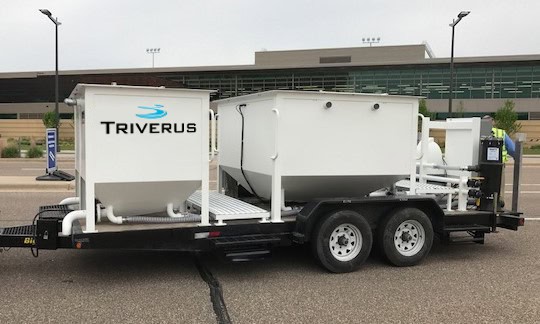
Zero Discharge. Continuous Operation. Complete Stormwater Compliance.
The Triverus Water Treatment Trailer (WTT) is a purpose-built on-site water treatment system designed to pair with the Triverus MCV for large-scale pervious pavement cleaning and parking facility maintenance. As the MCV collects contaminated wash water through its Clean Loop® recovery system, the WTT processes that water through a 4-stage classification and treatment cycle — returning clean process water directly to the MCVs for continued cleaning operations.
The result is a completely closed-loop, zero-discharge cleaning operation. No wastewater leaves the site. No water trucks. No municipal disposal permits. The WTT eliminates the single biggest logistical constraint on large-area pervious pavement maintenance — enabling uninterrupted cleaning across facilities of any size.
Water Treatment Trailer Specification Sheet
Key Capabilities
How the WTT Cleans and Returns Water to Service
01
Coarse Solids Removal
Incoming wash water from the MCV is received into the first treatment stage, where large particulates — sand, gravel, debris, and particles above 1/4 inch — are separated and collected. This protects downstream equipment and begins concentrating the waste stream.
02
Pre-Treatment Filtration
The water passes through a pre-treatment filtration stage to remove medium-sized solids and organic material. This stage reduces turbidity and prepares the water for fine-particle classification.
03
Fine Particle Classification
Water flows through fine-particle classification, capturing particles down to 5 microns. This includes tire wear residue (including 6PPD), copper and zinc compounds, oil and grease droplets, and other fine contaminants associated with stormwater pollution.
04
Clean Water Recovery
Clarified process water exits the treatment trailer and is returned directly to the MCV for immediate reuse in cleaning operations. The closed-loop cycle repeats throughout the entire shift, allowing continuous operation without water interruption or wastewater discharge.
Large-Area Cleaning Without Water Logistics Constraints
Pervious and permeable pavement systems require periodic high-pressure cleaning to restore infiltration rates — but large commercial lots, campuses, and municipal installations present a logistical challenge: how do you supply enough clean water and dispose of contaminated wash water without stopping?
The WTT solves this entirely. A single WTT services two MCVs simultaneously, processing 350 gallons per cycle in under 10 minutes. The MCVs never leave the work area for water. The entire operation is zero-discharge compliant.
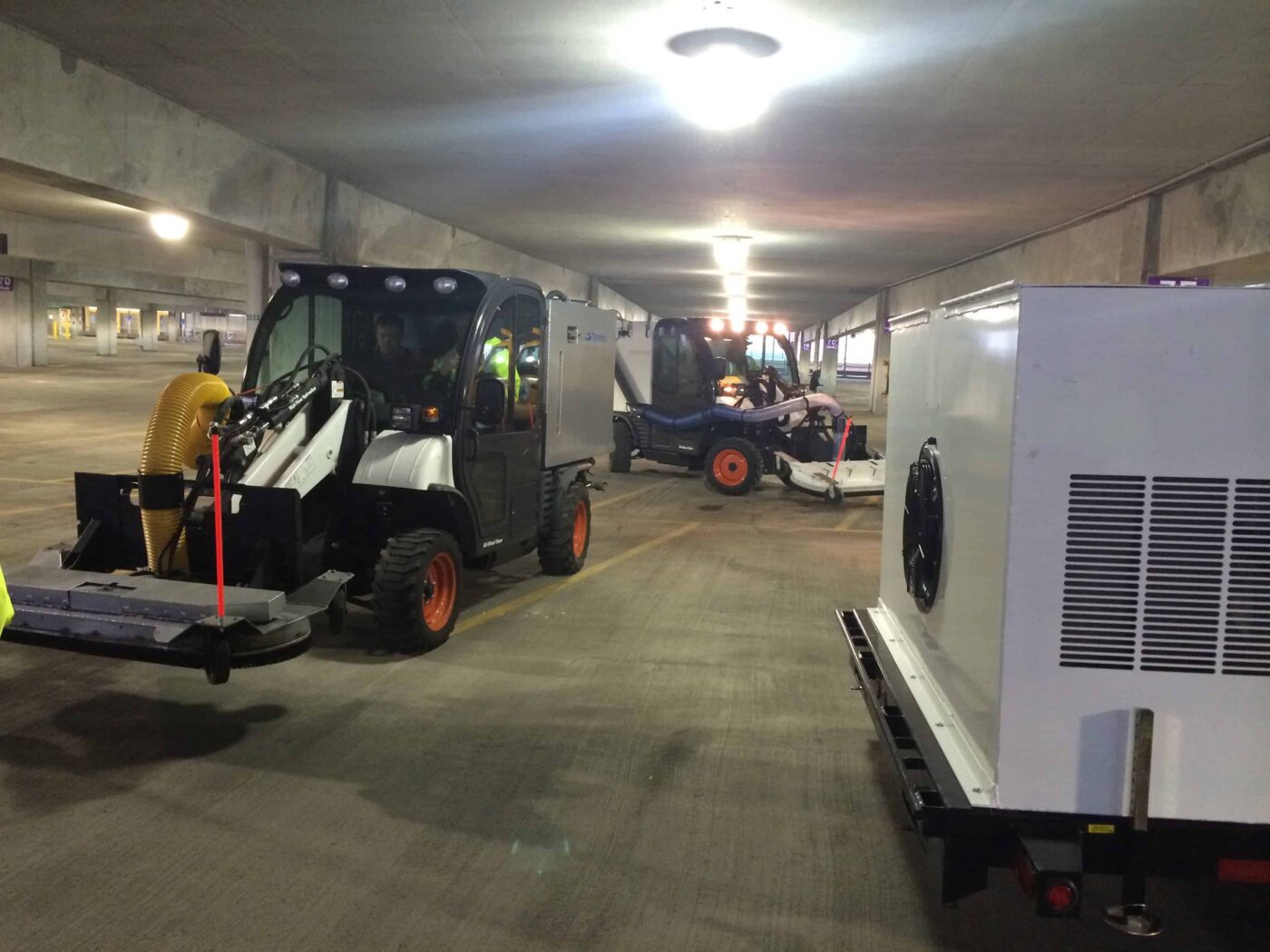
Environmental Compliance for High-Traffic Cleaning Operations
For airports, military installations, and government facilities where environmental compliance is non-negotiable, the WTT provides documented, auditable zero-discharge capability. All recovered water is treated on-site; waste is captured as concentrated solids with a reduced disposal footprint. The WTT operates alongside the MCV as a complete cleaning system — no off-site water treatment required.
Resources & Documentation
⚠ REVIEW NOTE: No WTT-specific brochure was found in the media library. The downloads below are general Triverus resources. If a WTT product sheet exists, upload it to the media library and add an arrow link here. Remove this note before launch.
Frequently Asked Questions
How does the WTT work with the Triverus MCV?
The WTT is positioned at the work site. As each MCV completes a cleaning pass, it returns to the WTT to offload its tank of contaminated wash water. The WTT processes that water through its 4-stage treatment system in under 10 minutes, returning clarified process water to the MCV. A single WTT services two MCVs simultaneously, so neither vehicle is idle waiting for a water cycle to complete.
What happens to the waste collected by the WTT?
The WTT concentrates captured contaminants into a solid waste stream. The resulting waste is a relatively small volume of concentrated solids that can be collected and disposed of appropriately — far more manageable than disposing of large volumes of contaminated liquid wastewater. Contact Triverus for guidance on local disposal requirements.
Can the WTT support stormwater permit compliance documentation?
Yes. The WTT+MCV system operates as a closed loop with zero discharge to stormwater infrastructure, directly supporting SWPPP and NPDES permit requirements. The system eliminates the risk of contaminated wash water entering storm drains — a key concern for sites where oil, grease, heavy metals, and tire wear particles accumulate on pavement surfaces. Triverus can provide documentation to support permit compliance filings.
What size facility can the WTT and MCV handle in a single shift?
Cleaning coverage depends on pervious pavement condition, cleaning depth, and number of MCVs deployed. A single MCV cleans at 5,000–35,000 ft²/hr depending on configuration and clogging level. With two MCVs alongside a single WTT, large commercial lots, college campuses, and airport facilities can be serviced in a single shift without water resupply interruption. Contact Triverus for a site assessment and production estimate.
Is the WTT available for purchase or only as part of a service package?
The WTT is available for direct purchase, designed to pair with one or two Triverus MCVs as a complete cleaning system. Triverus provides training and support for operating the combined MCV+WTT system. Contact Triverus to discuss pricing, configuration, and deployment options for your facility.